The anxiety cycle starts with a trigger and can feel automatic. A thought about danger leads to body sensations, then to avoidance or safety behaviors, which bring short-term relief. Over time, this loop trains the brain to respond more strongly in similar situations.
This page is educational, not a diagnosis. If symptoms persist or worsen, a qualified provider can evaluate care options. For many people, repeated avoidance makes fears grow and limits daily life.
The article will explain what anxiety is, how the brain and body change, common symptoms and panic attacks, disorder types, risk factors, and evidence-based ways to break the cycle.
Understanding the loop helps reduce stigma. Anxiety is a common human response that becomes problematic when it repeatedly disrupts functioning.
Practical takeaway: progress usually comes from learning skills and gradually approaching feared situations, rather than organizing life around avoidance.
Key Takeaways
- The cycle: trigger → anxious thoughts → sensations → avoidance → short relief → stronger anxiety.
- Avoidance reduces discomfort short-term but increases long-term risk.
- This content is educational and not a clinical diagnosis.
- Skills and gradual exposure help people regain functioning.
Anxiety vs. anxiety disorders: what’s normal and what’s not
Many people feel nervous sometimes, but clinical problems show when worry is constant, widespread, and harms daily functioning.
When worry becomes persistent, widespread, and disruptive over time
When concern crosses the line
A true anxiety disorder involves feelings that do not go away. They appear in many situations and can worsen over time. The person may notice repeated symptoms that reduce their ability to act.
How worry interferes with daily life
Disruption shows up in clear ways at work, in class, and at home. Missed deadlines, trouble focusing on schoolwork, and skipping social events are common signs.
- Performance at work or school drops because concentration suffers.
- Relationships feel strained when someone avoids plans or cancels often.
- Routines get reorganized around preventing fear instead of pursuing valued goals.
These patterns can reinforce themselves: avoiding one situation makes new fears grow, and the cycle strengthens over months. Anxiety disorders and related disorders are common and treatable. Early assessment helps limit compounding problems, and support can prevent severe outcomes such as refusing to leave home.
How the anxiety cycle works in the brain and body
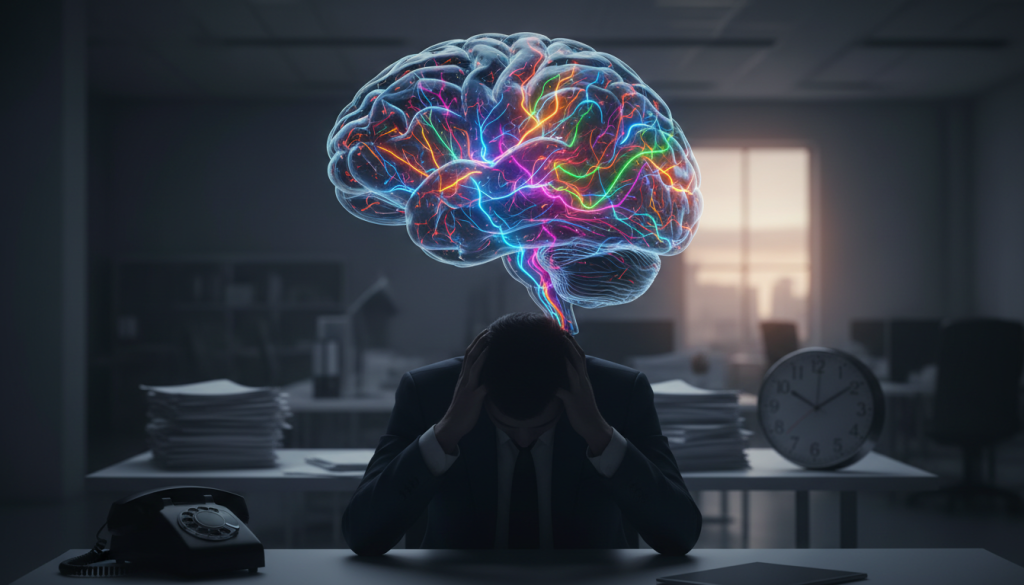
The mind and body react together when a person senses danger. This fast alarm helps in real threats, but it can also trigger when threat is only perceived.
The stress response releases adrenaline and cortisol. These hormones raise the heart rate, speed breathing, and cause sweating. Those sensations feel urgent and can push the body into a fight-or-flight state.
The stress response: adrenaline, cortisol, and the fight-or-flight alarm
Adrenaline gives quick energy; cortisol shifts resources to handle the moment. Together they create physical symptoms that demand attention.
How physical sensations can be misread as danger
Increased heart rate, rapid breathing, and sweating are normal. But when someone interprets these as signs of collapse or loss of control, fear grows.
Catastrophic thoughts — such as assuming the worst — amplify sensations. Focusing on symptoms makes them feel stronger and keeps the alarm active.
Why the cycle strengthens when it repeats in many situations
When the brain pairs certain situations with the alarm and an escape response, it learns “this equals danger.” Over time, reactions come faster and more often across different situations.
- Physical cues trigger worried thoughts that increase symptoms.
- Repeated pairing of escape and relief teaches the brain to avoid similar situations.
- Some symptoms overlap with other health conditions, so professional assessment is important when new or intense signs appear.
Because avoidance reduces discomfort quickly, it feels effective in the short term. However, this “quick fix” strengthens learning that the situation is dangerous, making the cycle harder to break over time.
Why avoidance keeps people stuck
Avoiding feared triggers may feel smart in the moment, but it often strengthens the habit that keeps problems going. Relief after escape acts as a reward and teaches the brain to use avoidance as a primary coping tool.
Short-term relief vs. long-term growth
Escaping reduces distress now, which is why it repeats. Over months, the brain never tests the feared outcome and the original worry grows stronger.
How avoidance spreads to new situations
One avoided trip to a crowded store can widen. It may become all stores, then driving, then limiting daily activities. This generalization tightens limits on life and independence.
Safety behaviors that seem helpful
Safety behaviors—like checking exits, constantly searching symptoms online, or always bringing a trusted person—feel useful. Yet they prevent new learning and keep fear beliefs intact.
The hidden costs
Over time, avoidance shrinks options, strains family relationships, and removes social and recreational activities that support well-being. In severe cases, a person may refuse to leave home, a sign the disorder needs professional attention (NIMH).
Common signs and symptoms that show up in the anxiety cycle
Symptoms appear in three linked areas: the body, the mind, and everyday behavior. Noticing patterns helps a person describe what is happening and plan next steps.
Physical warning signs
Physical signs often include a racing heart, sweating, trembling, and shortness of breath. These sensations can also include dizziness, nausea, tingling, or a sense of losing control.
Such body reactions feel alarming because they mimic real medical events. That makes a person more likely to avoid the situation to stop the discomfort.
Mental patterns that intensify distress
Common mental signs include persistent worry, intrusive thoughts, and a sense that things are out of control. These thoughts focus attention on symptoms and raise distress.
Worry often asks “what if” questions that predict worst-case outcomes. That thinking pattern keeps the alarm active and strengthens avoidant habits.
Behavioral shifts and their costs
Behavior changes include checking, reassurance-seeking, and avoiding social situations. These strategies reduce discomfort briefly but teach the brain that escape works.
Over time, avoiding places or people narrows daily life and harms overall health and functioning.
Tracking and when to get help
Track triggers, sensations, thoughts, actions, and outcomes to provide clear information to a clinician. Note what happened, how the heart felt, what thoughts ran through the mind, and what the person did next.
If symptoms are frequent, worsening, or interfere with work and social situations, professional support is appropriate. Panic-like spikes can overlap with ongoing symptoms and deserve prompt assessment.
Panic attacks and panic disorder: when fear spikes suddenly

Sudden panic spikes can feel like a medical emergency, even when the body is responding to stress. Understanding what happens can make the episode easier to ride out and reduce added worry about future attacks.
Typical symptoms and why they feel so alarming
Panic attacks are abrupt surges of intense panic with strong physical signs. The body floods with adrenaline, so sensations can feel life‑threatening.
- Racing heart, sweating, trembling, and shortness of breath
- Dizziness, nausea, tingling, or a sense of losing control
- Catastrophic thoughts such as “I’m having a heart attack” or “I will pass out”
What to expect: most episodes peak and pass within 5 to 30 minutes
Panic often rises fast, peaks, and then falls over a short time window. Knowing this helps people tolerate the wave rather than escalate with fear of fear.
When repeated attacks become panic disorder and when to get help
When someone has repeated panic attacks plus ongoing worry or behavior change, clinicians may diagnose panic disorder. That diagnosis emphasizes patterns, not blame.
Seek urgent medical care for any new, severe, or unusual symptoms. For recurrent episodes or persistent avoidance, a mental health evaluation is appropriate to discuss treatment and related conditions.
Types of anxiety disorders and how avoidance can look different in each
Clinicians group feared responses into categories that explain why avoidance varies. The major types help show common targets, yet avoidance is a shared learning process across conditions.
Generalized worry and daily preoccupation
Generalized anxiety disorder often shows as constant “what if” worry. A person overprepares, seeks constant reassurance, or mentally ruminates to try to prevent uncertainty.
Those efforts act as avoidance; rumination feels like problem solving but keeps fear active.
Fear of social judgment
Social anxiety disorder centers on feared evaluation in social or performance settings. People use safety scripts and self-monitoring to reduce risk, which prevents learning that judgment is often harmless.
Phobias tied to specific triggers
Phobias link fear to objects or settings (flying, needles, animals, elevators). Avoidance is usually immediate and can generalize quickly to related situations.
Note: Co-occurring patterns are common, so assessment guides treatment. Biology, life events, and the environment shape which disorders emerge and when.
Who is affected and what increases risk over a lifetime
About one in three U.S. adolescents and adults will experience an anxiety disorder at some point, so these disorders are common across the lifespan and not a personal failure.
What research shows about risk
Current studies point to both genetic and environmental factors. Family history, brain development, and life circumstances all play a role, so risk usually reflects a mix rather than a single cause.
Major life events and transitions
Pregnancy, trauma, illness, bereavement, job or school changes, and moving can raise vulnerability. The college transition and heavy social media use also predict increased symptoms in youth.
Children, teens, and adults: changing needs
In children and teens, school demands and social development shape how conditions show and what supports help. Adults may face work, parenting, and health stressors that alter coping needs over time.
- Overlap: anxiety disorders often co-occur with depression and eating disorders, which can complicate treatment.
- When to seek help: seek mental health services if symptoms persist, worsen, or interfere with daily functioning. Help is common and effective.
Breaking the cycle: evidence-based ways to reduce avoidance
Combining targeted therapy with daily skills and peer support gives people clear ways to reduce avoidance and regain functioning.
Therapy that targets fear learning
Cognitive behavioral therapy (CBT) and exposure-based approaches help people approach triggers in a planned, stepwise way.
These treatments reduce safety behaviors and retrain the brain by repeated, measured practice of feared situations.
Practical skills to support progress
Short breathing techniques, sleep consistency, regular meals, and daily movement (walking, swimming, yoga) lower baseline stress.
Gradual practice uses a hierarchy of situations, repeated sessions, and tracking distress over time to make exposure achievable.
Medication and coordinated care
Medication may be part of treatment planning with a licensed provider. It often supports therapy rather than replacing skill work.
Peer groups and tracking outcomes
Peer support or group therapy reduces shame and offers accountability and practical coping ideas for people with anxiety disorders.
Track triggers, thoughts, avoidance, and outcomes to show progress and inform clinical planning.
Overlap with other conditions and where to get help
When symptoms overlap with depression or other conditions, integrated care improves results. Primary care, licensed therapists, and SAMHSA resources can help people in the United States find local services.
If someone is in crisis or at risk, seek urgent medical or emergency support immediately.
Conclusion
Breaking the loop means moving from quick escape to steady, planned practice that weakens fear and restores more of daily life.
Short-term relief from avoidance trains the brain to expect danger. Over time this pattern makes anxiety stronger. Evidence-based care and small, repeated approaches retrain responses and reduce symptoms.
Recognize that anxiety disorders are common and treatable. A practical first step can be tracking a trigger, scheduling an evaluation, starting CBT, or building a simple exposure plan. Trusted clinicians, family, or peer support improve outcomes.
If someone is struggling or having thoughts of suicide, call or text the 988 Suicide & Crisis Lifeline at 988 or chat at 988lifeline.org for immediate help in the United States. In life‑threatening situations, call 911.